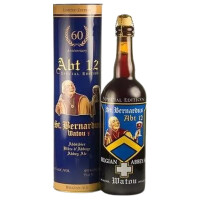
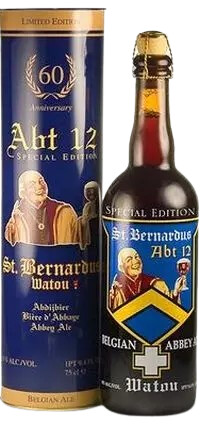
Abt 12 Special Edition
St. Bernardus Brouwerij in Watou, West Flanders, Belgium 🇧🇪
Belgian Style - Quadrupel / Dark Strong Regular Out of Production|
Score
7.93
|
|
The St. Bernardus Abt 12 is recognized as one of the best ales in the world. For the occasion of our 60th anniversary, our brewmaster Bert Van Hecke created a unique and special variety of the St. Bernardus Abt 12. This "Special Edition" (2011 only) contains hops from Poperinge: Challenger and Golding, and has been brewed with black, amber, munich and pale ale malts.
Sign up to add a tick or review

8.5/10
—
Appearance 8
Aroma 8
Flavor 8
Texture 10
Overall 9
Initially huge, yellowish gray head, fast reduced to 1cm rim above dark brown beer, shot with amber, red and purple. Initially fresh greenery nose, parsley; also colour pencil. Then dark and roasted malts appear, hints at (typically continental) hops and speculoos (gingerbread). Warming up, this gets winey, and aromas of blue grapes. Initial taste is dry, nearly wry- bitterish, but it is as a thin film over a boiling, sugars-ridden turmoil; sweet, dark, syrupy, with hints of spruce, berries, chocolate (a lot), plums. Glides from bitter full-chocolate to creamy "praliné". Warming up stresses this impression, of course. There’s even a hint of sourness, though I suspect the lively carbonation. Near-fizzy and burning MF. Initially thick, velvety texture, especially if one adds the loss of body by the - very present - alcohol. Quite some higher alcohols too, I guess. Impressive balance (if anything departs it from the regular Abt 12, its this balance) for such a ’big’ and relatively recently bottled beer. In the aftertaste, after some warming up, I get the classical St. Bernardus figs flavour. I followed a 2-speed timing for this tasting: a first chalice, straight after opening from the fridge, then a second, after letting the bottle warm up in a dark, but not cool spot. No doubt: this beer has to be drunk at a (not too cool) cellartemperature to fully appreciate its complexity. The only thing that gets lost warming up is the initial, fleeting hoparoma. No doubt this beer deserves some serious cellar-aging.
Tried
from Bottle
on 11 Jul 2006
at 14:32