Skorzeny
Macken Bryggeri in Stockholm, Stockholm, Sweden 🇸🇪
Bock - Doppelbock Regular|
Score
6.57
|
|
Grim Doppelbock with dark reddish copper hues & an ivory foam head like sharp wolf fangs. Its flavour undergoes a lycanthropic transformation of rich malt character into a fruity and caramel tones rounded by noble hop bitterness. Beware the moon!
A werewolf (old English: werwulf, "man-wolf") or lycanthrope (Greek: λυκάνθρωπος, "wolf-person") is a human with the ability to shape-shift into a wolf, either by conscious choice or by curse.
For centuries, werewolves have been an intriguing and daunting source of fear and mystery in Western folklore. Birthed in the medieval period, that fascination has far from waxed or waned through time. They represent the primal and unrestrained animalistic side of human nature, including but not limited to sexual arousal and intercourse, the dichotomy of our personalities, and a link between man and wolf, we as creatures alienated from both.
The werewolf transformation stands for the paradox of our never-ending battle to control our inner urges and the loss of our self-control and liberation of our true nature. The release of our beast within!
Early sources of lycanthropy can be traced back to ancient Greek mythology, such as in the story of the Arcadian king, Lycaon, who tested Zeus by serving him a dish made out of his slaughtered son to find out if Zeus truly was all-knowing. As punishment for the test, Zeus transformed Lycaon into a wolf.
The belief in werewolves was widespread based on legends influenced by pre-14th century medieval theology, in which the werewolf was a satanic beast with a craving for human flesh. Lycanthropy was the most common accusation after witchery in the European witch-hunts and trials, most notably in the Valais witch trials in the 15th century. A number of treatises were even written on werewolves in France during the late 16th and early 17th centuries. In the Alpine countries the belief in werewolves strongly remained until the 18th century.
In the early 20th century the werewolf took center stage in numerous short stories and novels published in both the United Kingdom and United States. The English writer Algernon Blackwood wrote a number of werewolf short stories, as well as some American pulp magazine stories published by Weird Tales, with contributing authors such as Robert E. Howard, H. Warner Munn, and Seabury Quinn.
In the cinema art of the silent era, werewolves were portrayed in canine form, in films like The Werewolf (1913) and Wolf Blood (1925). The first feature film to portray an anthropomorphic werewolf was Werewolf of London (1935).
It was not until the 80’s, however, that the splendor of werewolves in popular culture gained a strong foothold. In 1981, two breakthrough werewolf films, The Howling, directed by Joe Dante, based on the novel of the same name by Gary Brander, and An American Werewolf in London, written and directed by John Landis, were screened. Just two years later Stephen King's horror fiction novel, Cycle of the Werewolf, was published. And from 1987-1988, the TV series, Werewolf, directed by Frank Luppo, was aired on Fox network. These American cinematic and fiction literature masterpieces have distributed lycanthropy to the world arena, generating a permanent and deep attraction to this belief by the collective imagery.
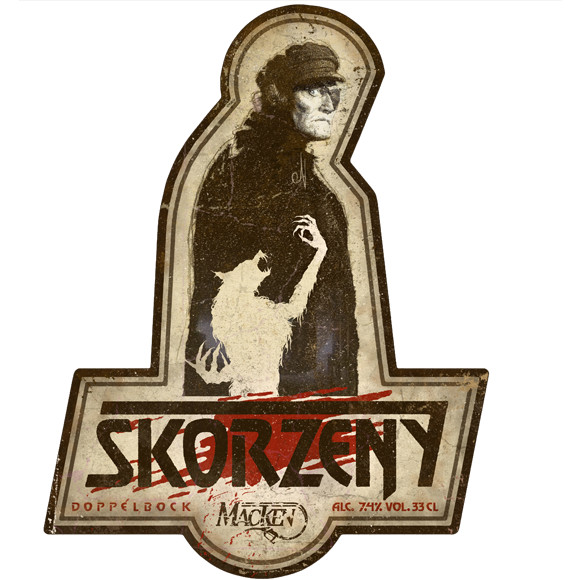
Inspired by this captivating, supernatural subject since our childhood, we pay homage with our Doppelbock “Skorzeny” to the aforementioned 80’s werewolf cinematic and literature chef d'oeuvre. Stay on the road and keep clear of the moors. Beware the moon!
A werewolf (old English: werwulf, "man-wolf") or lycanthrope (Greek: λυκάνθρωπος, "wolf-person") is a human with the ability to shape-shift into a wolf, either by conscious choice or by curse.
For centuries, werewolves have been an intriguing and daunting source of fear and mystery in Western folklore. Birthed in the medieval period, that fascination has far from waxed or waned through time. They represent the primal and unrestrained animalistic side of human nature, including but not limited to sexual arousal and intercourse, the dichotomy of our personalities, and a link between man and wolf, we as creatures alienated from both.
The werewolf transformation stands for the paradox of our never-ending battle to control our inner urges and the loss of our self-control and liberation of our true nature. The release of our beast within!
Early sources of lycanthropy can be traced back to ancient Greek mythology, such as in the story of the Arcadian king, Lycaon, who tested Zeus by serving him a dish made out of his slaughtered son to find out if Zeus truly was all-knowing. As punishment for the test, Zeus transformed Lycaon into a wolf.
The belief in werewolves was widespread based on legends influenced by pre-14th century medieval theology, in which the werewolf was a satanic beast with a craving for human flesh. Lycanthropy was the most common accusation after witchery in the European witch-hunts and trials, most notably in the Valais witch trials in the 15th century. A number of treatises were even written on werewolves in France during the late 16th and early 17th centuries. In the Alpine countries the belief in werewolves strongly remained until the 18th century.
In the early 20th century the werewolf took center stage in numerous short stories and novels published in both the United Kingdom and United States. The English writer Algernon Blackwood wrote a number of werewolf short stories, as well as some American pulp magazine stories published by Weird Tales, with contributing authors such as Robert E. Howard, H. Warner Munn, and Seabury Quinn.
In the cinema art of the silent era, werewolves were portrayed in canine form, in films like The Werewolf (1913) and Wolf Blood (1925). The first feature film to portray an anthropomorphic werewolf was Werewolf of London (1935).
It was not until the 80’s, however, that the splendor of werewolves in popular culture gained a strong foothold. In 1981, two breakthrough werewolf films, The Howling, directed by Joe Dante, based on the novel of the same name by Gary Brander, and An American Werewolf in London, written and directed by John Landis, were screened. Just two years later Stephen King's horror fiction novel, Cycle of the Werewolf, was published. And from 1987-1988, the TV series, Werewolf, directed by Frank Luppo, was aired on Fox network. These American cinematic and fiction literature masterpieces have distributed lycanthropy to the world arena, generating a permanent and deep attraction to this belief by the collective imagery.
Inspired by this captivating, supernatural subject since our childhood, we pay homage with our Doppelbock “Skorzeny” to the aforementioned 80’s werewolf cinematic and literature chef d'oeuvre. Stay on the road and keep clear of the moors. Beware the moon!
Sign up to add a tick or review

6.2/10
—
Appearance 8
Aroma 6
Flavor 6
Texture 6
Overall 6
Bottled. Deep brown colour, with a small off- white foamy head. Aroma is sweet malts, some mild alcohol as well as some toffee, mild spiced and some dried fruity notes. Flavour is mild toast, sweet malts, some alcohol and mild fruitiness. Surprisingly thin body for being 7.4 %.
Tried
from Bottle
on 19 Apr 2023
at 14:21