Vagrant's Pomona Project Cider Orchard No. 9
Vagrant Cider in Penryn, Cornwall, England 🏴
Cider - Perry Series|
Score
6.65
|
|
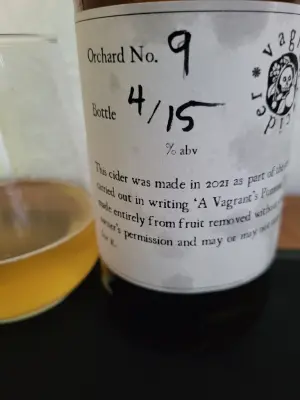
This perry was made in 2021 as part of the research carried out in writing 'A Vagrant's Pomona'. It is made entirely from fruit removed without the owner's permission and may or may not taste better for it.
Orchard 9
3-11-21 1220-1330 sunny 11°C
This is the first of final run of three locations on my old
turf and I’m planning to hit them all today. In fact, this
orchard is a late entrant I hadn’t considered previously as
the target are pears and my original intention had been
cider only rather than Perry, but here we are. I hadn’t
previously visited this orchard, but knew of its existence. I
had received a tip off that the pollinators of this particular
site, the main crop being Conference, are Duchesse
d’Angouleme, a dessert variety of truly heroic proportion.
As with many orchards in Kent planted in the eighties and
nineties, these trees are dwarf bush goblet form in nice
neat rows, the size enabling harvest stood on the ground.
We faff around for a bit trying to find a suitable way in,
mob-handed today with Tess, Tess’ friend Alison, the kids
and dog, it proves difficult to get access without dragging
through a hedge, so we ditch the idea of all getting stuck
in and leave kids and dog with Ali while Tess and I jump
fence and bramble to get on with it.
The afternoon is idyllic mid-autumn and it really feels a
pleasure to be back in this part of the world and the fruit
on offer doesn’t disappoint. These pears are absolutely
enormous. Comparable in size to a cantaloupe melon,
they are loaded with softly-aromatic, honey-sweet juice,
weigh a tonne and fill bags quickly. We laugh as we pick
them, feeling like kids, it promotes various kinds of
playground humour mostly associated with ideas relating
to pairs of different kinds. This fruit is insane. The only
drawback from a fermenting point of view, is that once
the sugar has been fermented out, all I’ll be left with here
is a very little acidity (when I press the juice, it reads at a
pH of 4.0 – a bit high really), a sweetness remaining from
the non-metabolised sugars in the form of sorbitol and
hopefully the floral aromatics. This will likely make for
a very flabby drink that has a chemical hint of Tennent’s
Super about it – not really what I’m after. True Perry
pears tend to varieties with a very high astringency, some
with insane tannins, and some with high acidity, which
gives the drink its depth of flavour and contributes to
mouthfeel. Perry making seems a bit of a dark art to me.
I’ve never tried it before and any written information
available tends to be tacked on as an afterthought to cidermaking
manuals. To put that in some context, you’ll get
far more from the Perry pear entry on Wikipedia than
most books. I gather there are numerous pitfalls and the
chances of making something entirely undrinkable are
high, so a bit of a risk making my debut here with fruit not
intended for this use, but I’ve never been shy of a try, so
we’ll see. I do need to get something tannic and astringent
in this blend though and as it happens, the neighbouring
orchard has cordon Braeburns with Red Sentinel crabs
as a pollinator, just the ticket. These crimson, cherrysized
apples are juicy and sweet, but also possessed of a
face wrenching astringency and a dose of tannin like a
punch to the throat. Not exactly subtle, but as a minor
component by weight in this blend, I’m hopeful for a bit
of extra mouthfeel and depth of flavour. I fully appreciate
the purists will be rolling eyes in horror combining apple
and pear thereby making a Pyder, but it is what it is and
co-ferments are apparently de rigueur these days, besides,
if Denis Gwatkin has the beard for it (and he certainly
does) then that’s something to aspire to. Worlidge also
recommended addition of crab apples to Perry to aid in
preservation and flavour. The gamble being this: Pears are
even more reticent about relinquishing their juice than
apples and normally require a 24hr period of maceration
after pulping, the start of the oxidisation process allowing
a greater breakdown of the cell walls, this also allows for a
softening of tannin in Perry pears, but that’s not an issue
here. Consequently, I mill the crabs at the same time as
the pears, hopeful the crab pulp will act as a marinade to
the pears. Sound like a load of rubbish? It might be, that
remains to be seen.
Perry pears in their true form have made a very recent
appearance in my life. There are none that I know of in
Kent, nor are there any wild pears or feral pears I know
the whereabouts of up here. Perry is not a drink served
in pubs or readily available in shops outside the three
heartland counties of Herefordshire, Gloucestershire
and Worcestershire, other than the Fosters equivalent
Babycham, so it’s been late to my radar. I’m trying to
make up for lost time. Last month, I was fortunate to
attend the memorial function in celebration of the life
of Gillian Bulmer at the Cider Museum she founded on
the site of her family’s original factory. It’s a very nicely
curated museum with much for the cider enthusiast to
smile at. I was also extremely fortunate to spend the rest
of my afternoon in Hereford in the company of Rob and
George Uren who took myself and Andrew Ormerod on
a tour of some of the most fantastic orchards I’ve ever
seen, including the original Adams Hill orchard and its
replication on adjacent land. But most impressively for
me, I saw for the first time, Perry pear trees in their stately
finest. These trees are enormous by orchard standards,
at least they certainly seemed that way to me, raised as I
am on a diet of half standards and bush orchards. Sixty
feet tall some of these, decked in the most beautiful fruit
with names like Butt, Gin, Thorn, Oldfield, Stinking
Bishop, Merrylegs and Dead Boy, foliage just beginning to
turn at the time of my visit, the colours are gold through
vivid scarlet. I was gobsmacked. Rob has such a depth of
knowledge and experience in the management of these
trees, it really was an honour to spend the afternoon in his
company and sets my mind to the future. There are very
few Perry pear trees in Cornwall, although an orchard has
been planted now by Gould’s at Grampound Road. Also,
I know of only a handful of wild trees, but these show
future promise, so who knows. If this blend turns out
something drinkable, I’ll be as surprised as anyone.
Orchard 9
3-11-21 1220-1330 sunny 11°C
This is the first of final run of three locations on my old
turf and I’m planning to hit them all today. In fact, this
orchard is a late entrant I hadn’t considered previously as
the target are pears and my original intention had been
cider only rather than Perry, but here we are. I hadn’t
previously visited this orchard, but knew of its existence. I
had received a tip off that the pollinators of this particular
site, the main crop being Conference, are Duchesse
d’Angouleme, a dessert variety of truly heroic proportion.
As with many orchards in Kent planted in the eighties and
nineties, these trees are dwarf bush goblet form in nice
neat rows, the size enabling harvest stood on the ground.
We faff around for a bit trying to find a suitable way in,
mob-handed today with Tess, Tess’ friend Alison, the kids
and dog, it proves difficult to get access without dragging
through a hedge, so we ditch the idea of all getting stuck
in and leave kids and dog with Ali while Tess and I jump
fence and bramble to get on with it.
The afternoon is idyllic mid-autumn and it really feels a
pleasure to be back in this part of the world and the fruit
on offer doesn’t disappoint. These pears are absolutely
enormous. Comparable in size to a cantaloupe melon,
they are loaded with softly-aromatic, honey-sweet juice,
weigh a tonne and fill bags quickly. We laugh as we pick
them, feeling like kids, it promotes various kinds of
playground humour mostly associated with ideas relating
to pairs of different kinds. This fruit is insane. The only
drawback from a fermenting point of view, is that once
the sugar has been fermented out, all I’ll be left with here
is a very little acidity (when I press the juice, it reads at a
pH of 4.0 – a bit high really), a sweetness remaining from
the non-metabolised sugars in the form of sorbitol and
hopefully the floral aromatics. This will likely make for
a very flabby drink that has a chemical hint of Tennent’s
Super about it – not really what I’m after. True Perry
pears tend to varieties with a very high astringency, some
with insane tannins, and some with high acidity, which
gives the drink its depth of flavour and contributes to
mouthfeel. Perry making seems a bit of a dark art to me.
I’ve never tried it before and any written information
available tends to be tacked on as an afterthought to cidermaking
manuals. To put that in some context, you’ll get
far more from the Perry pear entry on Wikipedia than
most books. I gather there are numerous pitfalls and the
chances of making something entirely undrinkable are
high, so a bit of a risk making my debut here with fruit not
intended for this use, but I’ve never been shy of a try, so
we’ll see. I do need to get something tannic and astringent
in this blend though and as it happens, the neighbouring
orchard has cordon Braeburns with Red Sentinel crabs
as a pollinator, just the ticket. These crimson, cherrysized
apples are juicy and sweet, but also possessed of a
face wrenching astringency and a dose of tannin like a
punch to the throat. Not exactly subtle, but as a minor
component by weight in this blend, I’m hopeful for a bit
of extra mouthfeel and depth of flavour. I fully appreciate
the purists will be rolling eyes in horror combining apple
and pear thereby making a Pyder, but it is what it is and
co-ferments are apparently de rigueur these days, besides,
if Denis Gwatkin has the beard for it (and he certainly
does) then that’s something to aspire to. Worlidge also
recommended addition of crab apples to Perry to aid in
preservation and flavour. The gamble being this: Pears are
even more reticent about relinquishing their juice than
apples and normally require a 24hr period of maceration
after pulping, the start of the oxidisation process allowing
a greater breakdown of the cell walls, this also allows for a
softening of tannin in Perry pears, but that’s not an issue
here. Consequently, I mill the crabs at the same time as
the pears, hopeful the crab pulp will act as a marinade to
the pears. Sound like a load of rubbish? It might be, that
remains to be seen.
Perry pears in their true form have made a very recent
appearance in my life. There are none that I know of in
Kent, nor are there any wild pears or feral pears I know
the whereabouts of up here. Perry is not a drink served
in pubs or readily available in shops outside the three
heartland counties of Herefordshire, Gloucestershire
and Worcestershire, other than the Fosters equivalent
Babycham, so it’s been late to my radar. I’m trying to
make up for lost time. Last month, I was fortunate to
attend the memorial function in celebration of the life
of Gillian Bulmer at the Cider Museum she founded on
the site of her family’s original factory. It’s a very nicely
curated museum with much for the cider enthusiast to
smile at. I was also extremely fortunate to spend the rest
of my afternoon in Hereford in the company of Rob and
George Uren who took myself and Andrew Ormerod on
a tour of some of the most fantastic orchards I’ve ever
seen, including the original Adams Hill orchard and its
replication on adjacent land. But most impressively for
me, I saw for the first time, Perry pear trees in their stately
finest. These trees are enormous by orchard standards,
at least they certainly seemed that way to me, raised as I
am on a diet of half standards and bush orchards. Sixty
feet tall some of these, decked in the most beautiful fruit
with names like Butt, Gin, Thorn, Oldfield, Stinking
Bishop, Merrylegs and Dead Boy, foliage just beginning to
turn at the time of my visit, the colours are gold through
vivid scarlet. I was gobsmacked. Rob has such a depth of
knowledge and experience in the management of these
trees, it really was an honour to spend the afternoon in his
company and sets my mind to the future. There are very
few Perry pear trees in Cornwall, although an orchard has
been planted now by Gould’s at Grampound Road. Also,
I know of only a handful of wild trees, but these show
future promise, so who knows. If this blend turns out
something drinkable, I’ll be as surprised as anyone.
Sign up to add a tick or review
7/10
—
Appearance 7
Aroma 7
Flavor 7
Texture 7
Overall 7
Panda at home, thanks to Ed Danlo, 13/09/2026.
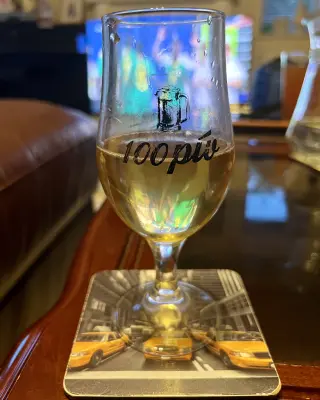
Light golden blonde with a fast escaping white head.
Nose is crisp apple, straw, light funk.
Taste comprises apple skins, straw, hedgerow, vinous, modest funk.
Medium bodied, moderate carbonation, drying close.
Okay if a little basic.
Light golden blonde with a fast escaping white head.
Nose is crisp apple, straw, light funk.
Taste comprises apple skins, straw, hedgerow, vinous, modest funk.
Medium bodied, moderate carbonation, drying close.
Okay if a little basic.
Tried
on 13 Sep 2026
at 14:57
6.5/10
—
Appearance 6
Aroma 6.5
Flavor 6.5
Texture 6
Overall 7
500ml bottle from Vagrant's Pomona Project "The Session" set. Orchard No. 9, Bottle 4/15. For #rgpm. Slightly hazed pale yellowy gold colour, bubbly foam head that dissipates away and aroma of pears, citric, funk hint. Taste is peary, floral, citrusy, with some light acidity and hint of tannin. Light bodied, light carbonation, drying peary finish. Quite drinkable.
Tried
from Bottle
on 25 May 2026
at 18:17