Vagrant's Pomona Project Cider Orchard No. 10
Vagrant Cider in Penryn, Cornwall, England 🏴
Cider - Dry Regular|
Score
6.70
|
|
This cider was made in 2021 as part of the research carried out in writing 'A Vagrant's Pomona'. It is made entirely from fruit removed without the owner's permission and may or may not taste better for it.
Orchard 10
3-11-21 1350-1510 sunny but chilling 8°C
This is a weird one in various ways. It’s probably what
could most likely be referred to as our home orchard and
sadly isn’t likely to be ours for much longer (not that it’s
actually ours). It belonged to Tess’ late father and has
been in her family’s possession for over thirty-five years.
I’ve been a part of this orchard’s life for twenty-six of
those and consequently, it’s very dear to me also. There
was a time I felt I’d never leave it.
A little over four acres, it comprises about seventy
trees now, half standards of about 4m height in a very
traditional large open goblet form. Given these trees are
about 110 years old, they are on rootstocks which predate
the modern East Malling series and consequently are
likely on one of the original strains of Paradise rootstock,
or possibly the now defunct Malling 2. The orchard was
planted for commercial Bramley’s Seedling production,
with Grenadier as a pollinator. Weirdly for a Bramley
orchard, this is the sole pollinator. Bramley is triploid,
meaning it has three sets of chromosomes rather than
two. Bramley, being self-sterile, requires the presence
of a self-fertile apple variety, like many crab-apples or
two other varieties capable of fertilising each other to
set fruit. This orchard has no crabs. Either the planter
was ignorant of the complexity in fertilising his chosen
variety, or he was simply reliant on the fact that his
orchard was among others on every side and pollination
would occur as a matter of course. As it happens, he was
right.
The traditional form orchard of large trees, widely
spaced, usually cruciform pattern, is almost entirely
absent from the area now. If you take a look at Brenchley
on Google maps, it’s one of the last three, in a sea of tiny
row cordon apples, mostly Braeburn, Gala and Jazz on
M27 or M9 stocks or small bush orchards with Bramley
and Cox on M26 stocks, also on borrowed time. It’s a
great sadness that these orchards are now all but absent
from the landscape here. They are iconic in cultural
memory and contribute something to the richness of our
experience as previously discussed.
As far as this orchard is concerned, it’s been a defining
feature of my adult life. The site of my first studio after
graduation from undergraduate study, I lived in the
house attached to it, belonging to Tess’ father on and
off until 2011, met and fell in love with my wife in it,
tended its trees, spent countless stoned hours on a ridemower
performing mowing acrobatics to cut the grass
below the low branches, which were all too ready to pin
you painfully against the mower seat if your attention
wandered for too long, hammock august afternoons,
late-night bonfires, birthday parties, barbecues and all
the dramas of human life. It’s tucked right in there close
to my heart. But until now, I’ve never fermented its fruit.
Made countless pies, crumbles, dried rings and sauce
for pork, yes, but never cider. The reason for this is that,
as you’ll be aware, the Bramley tends to be as sharp as
sin. When ripe, it also has a great deal of sugar, but this
is masked by its strident acidity. It’s this quality which
facilitates its reduction to a fine purée when cooked. The
accepted wisdom in the cider-making community is that
as a single variety, it ferments to something thin and far
too puckeringly sharp, even set against the venerated
Foxwhelp. It combines well with other varieties; for
instance, a recent collaboration between Ross-on-Wye
and Tenterden based Nightingale Cider saw it paired with
Dabinett to great and delicious success, but as a single
variety ferment, rarely (Heck’s being a notable exception).
I can totally see that this makes sense. If you look at the
photograph which compares the fruit from this orchard
to a standard commercial Bramley, I’m certain the first
noticeable difference is the size. David and Goliath. The
reason for this difference is mostly due to two factors –
a combination of age and doing nothing. When apple
trees achieve the venerable age these have, they are well
into decline, even by Bramley standards as a ridiculously
vigorous and long-lived apple variety. This means the tree
has less energy to devote to fruit production. Further,
these trees have received nothing in the way of chemical
intervention or fertilisation for at least forty years (the
previous owners were equally neglectful of inputs), where
the commercially managed orchards receive an annual
cocktail of fertilisers, soil amendments, insecticides,
fungicides, mole-ploughing to stimulate fruit production,
occasional girdling for the same reason &c. &c. However,
the main thing here is the absence of artificial nitrogen.
The commercial growers use it to maximise the sugar
content and crisp juiciness of their produce, but cider
makers rightly shun this input knowing that the flavour
for cider is greatly improved when the nutrient is lower.
Consequently, I’m taking another gamble. These tiny
fruit are thick of skin, cracked with scab, sun-filled with
a relatively larger proportion of skin surface-area in the
subsequent planned pomace and frankly, when I bite
into the fruit, sure, there’s still the bracing acidity, but
the sweetness comes through too and there’s definite
bitterness there, I’m sure of it. It might melt my teeth, but
it might be something exceptional in an other than teethmelting
way too.
We’re here today with Tess’ younger sister’s family for
food, fireworks and bonfire later, so while the twins,
Roland and Konrad run amok with their cousin, my
eldest, Morts, helps me with the picking pole and it’s him
in the photo here. The substance of the bag has a story
for this one too. It’s made with hessian from an old Tate
& Lyle sugar sack which was the under lining from an
enormous, Victorian, high-backed sofa owned by my
great, great grandmother which moved with me to the
studio when I took up residence in 1999.
Orchard 10
3-11-21 1350-1510 sunny but chilling 8°C
This is a weird one in various ways. It’s probably what
could most likely be referred to as our home orchard and
sadly isn’t likely to be ours for much longer (not that it’s
actually ours). It belonged to Tess’ late father and has
been in her family’s possession for over thirty-five years.
I’ve been a part of this orchard’s life for twenty-six of
those and consequently, it’s very dear to me also. There
was a time I felt I’d never leave it.
A little over four acres, it comprises about seventy
trees now, half standards of about 4m height in a very
traditional large open goblet form. Given these trees are
about 110 years old, they are on rootstocks which predate
the modern East Malling series and consequently are
likely on one of the original strains of Paradise rootstock,
or possibly the now defunct Malling 2. The orchard was
planted for commercial Bramley’s Seedling production,
with Grenadier as a pollinator. Weirdly for a Bramley
orchard, this is the sole pollinator. Bramley is triploid,
meaning it has three sets of chromosomes rather than
two. Bramley, being self-sterile, requires the presence
of a self-fertile apple variety, like many crab-apples or
two other varieties capable of fertilising each other to
set fruit. This orchard has no crabs. Either the planter
was ignorant of the complexity in fertilising his chosen
variety, or he was simply reliant on the fact that his
orchard was among others on every side and pollination
would occur as a matter of course. As it happens, he was
right.
The traditional form orchard of large trees, widely
spaced, usually cruciform pattern, is almost entirely
absent from the area now. If you take a look at Brenchley
on Google maps, it’s one of the last three, in a sea of tiny
row cordon apples, mostly Braeburn, Gala and Jazz on
M27 or M9 stocks or small bush orchards with Bramley
and Cox on M26 stocks, also on borrowed time. It’s a
great sadness that these orchards are now all but absent
from the landscape here. They are iconic in cultural
memory and contribute something to the richness of our
experience as previously discussed.
As far as this orchard is concerned, it’s been a defining
feature of my adult life. The site of my first studio after
graduation from undergraduate study, I lived in the
house attached to it, belonging to Tess’ father on and
off until 2011, met and fell in love with my wife in it,
tended its trees, spent countless stoned hours on a ridemower
performing mowing acrobatics to cut the grass
below the low branches, which were all too ready to pin
you painfully against the mower seat if your attention
wandered for too long, hammock august afternoons,
late-night bonfires, birthday parties, barbecues and all
the dramas of human life. It’s tucked right in there close
to my heart. But until now, I’ve never fermented its fruit.
Made countless pies, crumbles, dried rings and sauce
for pork, yes, but never cider. The reason for this is that,
as you’ll be aware, the Bramley tends to be as sharp as
sin. When ripe, it also has a great deal of sugar, but this
is masked by its strident acidity. It’s this quality which
facilitates its reduction to a fine purée when cooked. The
accepted wisdom in the cider-making community is that
as a single variety, it ferments to something thin and far
too puckeringly sharp, even set against the venerated
Foxwhelp. It combines well with other varieties; for
instance, a recent collaboration between Ross-on-Wye
and Tenterden based Nightingale Cider saw it paired with
Dabinett to great and delicious success, but as a single
variety ferment, rarely (Heck’s being a notable exception).
I can totally see that this makes sense. If you look at the
photograph which compares the fruit from this orchard
to a standard commercial Bramley, I’m certain the first
noticeable difference is the size. David and Goliath. The
reason for this difference is mostly due to two factors –
a combination of age and doing nothing. When apple
trees achieve the venerable age these have, they are well
into decline, even by Bramley standards as a ridiculously
vigorous and long-lived apple variety. This means the tree
has less energy to devote to fruit production. Further,
these trees have received nothing in the way of chemical
intervention or fertilisation for at least forty years (the
previous owners were equally neglectful of inputs), where
the commercially managed orchards receive an annual
cocktail of fertilisers, soil amendments, insecticides,
fungicides, mole-ploughing to stimulate fruit production,
occasional girdling for the same reason &c. &c. However,
the main thing here is the absence of artificial nitrogen.
The commercial growers use it to maximise the sugar
content and crisp juiciness of their produce, but cider
makers rightly shun this input knowing that the flavour
for cider is greatly improved when the nutrient is lower.
Consequently, I’m taking another gamble. These tiny
fruit are thick of skin, cracked with scab, sun-filled with
a relatively larger proportion of skin surface-area in the
subsequent planned pomace and frankly, when I bite
into the fruit, sure, there’s still the bracing acidity, but
the sweetness comes through too and there’s definite
bitterness there, I’m sure of it. It might melt my teeth, but
it might be something exceptional in an other than teethmelting
way too.
We’re here today with Tess’ younger sister’s family for
food, fireworks and bonfire later, so while the twins,
Roland and Konrad run amok with their cousin, my
eldest, Morts, helps me with the picking pole and it’s him
in the photo here. The substance of the bag has a story
for this one too. It’s made with hessian from an old Tate
& Lyle sugar sack which was the under lining from an
enormous, Victorian, high-backed sofa owned by my
great, great grandmother which moved with me to the
studio when I took up residence in 1999.
Sign up to add a tick or review
7.1/10
—
Appearance 8
Aroma 7
Flavor 6.5
Texture 8
Overall 7
Panda at home, thanks to Ed Danlo, 13/09/2026.
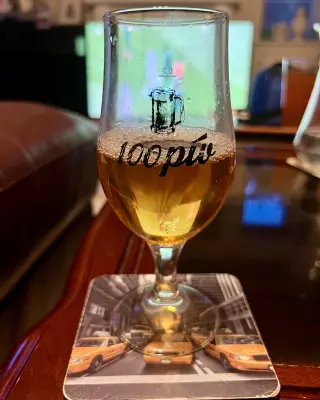
Golden copper with a white cap that escapes to the edge.
Nose is bitter sweet apple, straw, hedgerow, modest funk.
Taste comprises tannins, apple core, light funk.
Medium bodied, moderate carbonation, drying close.
Okay if a touch raw and home brew like.
Golden copper with a white cap that escapes to the edge.
Nose is bitter sweet apple, straw, hedgerow, modest funk.
Taste comprises tannins, apple core, light funk.
Medium bodied, moderate carbonation, drying close.
Okay if a touch raw and home brew like.
Tried
on 13 Sep 2026
at 14:51
6.8/10
—
Appearance 7
Aroma 7
Flavor 7
Texture 5
Overall 7
1/7/2026. Bottle shared by danlo, cheers Ed! Nice colour pour. Very sharp cider vinegar. Acidic citrus. Salty. Sharp green apple. Quite a mellow aroma which doesn’t really give any warning on what’s coming. Though quite liked it.
Tried
from Bottle
on 01 Jul 2026
at 20:52
6.4/10
—
Appearance 7
Aroma 6
Flavor 6.5
Texture 6
Overall 6.5
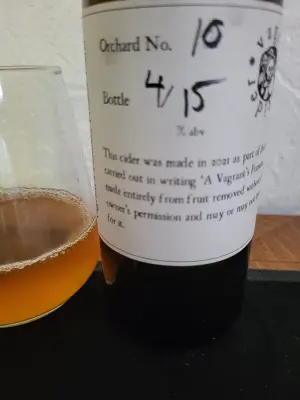
500ml bottle from Vagrant's Pomona Project "The Session" set. Orchard No. 10, Bottle 4/15. Deep golden amber colour, afew bubbles on top that dissipate to the rim and aroma of apple, core, ripe fruit. Taste is tart, tangy, appley, with lots of drying acidity and an acetic hint. Medium bodied, low carbonation, dry acidic finish. Quite drinkable, very much on the acidic side.
Tried
from Bottle
on 25 May 2026
at 18:36