
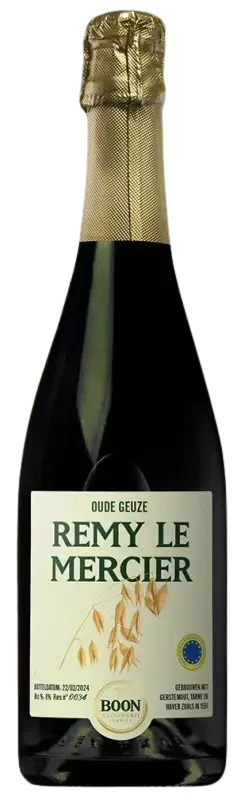
Oude Geuze Remy Le Mercier
Brouwerij F. Boon in Lembeek, Flemish Brabant, Belgium 🇧🇪
Lambic Style - Gueuze Special|
Score
7.70
|
|
Remy Le Mercier, a 16th-century tax collector from Halle, has been cited repeatedly by historians, past and present, for an ordinance he issued in 1559. The document prescribes the precise proportions of grains to be used in the local beer types “keut” and “houppe.” Brewers who deviated from these proportions were to be fined.
Today, the Halle ordinance is regarded as the oldest known reference to the origin of the lambic beer style — thanks to its specific grain ratios and geographical context.
Unusual by today’s lambic standards, however, is the mention of oats among the ingredients — a grain no longer found in modern lambic breweries. Yet, a composition of 10 % oats alongside at least 60 % barley malt and 30 % unmalted wheat would still meet current legal requirements for lambic.
A precursor of Lambic Oats, then. That the composition of some beers has evolved throughout history is beyond doubt. Technology has played a role, as has the often underestimated influence of regulation.
But for lambic and oude geuze, the ratios recorded by Le Mercier have remained strikingly similar in percentage terms: roughly 60 % barley, 40 % wheat, and (optionally, not mandatory) oats.
It should be noted that Le Mercier’s ordinance calculated grain proportions by volume (grain measures of 50 litres), whereas modern brewers work by weight (kilograms).
In earlier times, brewers used oats primarily because the oat husks acted as an ideal natural filter in the mash tun — necessary since the first wort was strained through so-called “basket filters.” Oats also lend a sweeter profile to the beer.
However, brewers rarely used more than 10 % oats, since their high fibre (beta-glucan) content tends to increase mash viscosity excessively.
Le Mercier’s ordinance specifically referred to the grain ratios for the beers keut and houppe. The latter can be seen as an early form of today’s lambic — a hopped beer (hence the name) with a mash rich in unmalted wheat, to which hops were added during the boil.
Another, slightly later document by J. B. Vrancken (1825) confirms this, stating that “lambiek was formerly brewed in Brussels, partly with oats or buckwheat as with wheat, one ingredient replacing the other.”
Boon puts it to the test!
Thanks to the meticulous record-keeping of Remy Le Mercier, we know that the origins of the lambic beer style date back at least to the 16th century. More than that — we have taken his description as inspiration for an exclusive Oude Geuze, bottled in a limited run of 5,400 bottles (75 cl) on 22 February 2024. We decided to put history to the test!
Because oats contain more fibre than barley, our lambic took a little longer to clarify, but time did its work beautifully.
With this Oude Geuze Remy Le Mercier, brewed with 10 % oats, we demonstrate that oats can indeed play a meaningful role in the production of Oude Geuze. They lend softness and fullness to the body and help strengthen the foam. The nutty character of the oats is clearly perceptible.
Santé! Proost!
Today, the Halle ordinance is regarded as the oldest known reference to the origin of the lambic beer style — thanks to its specific grain ratios and geographical context.
Unusual by today’s lambic standards, however, is the mention of oats among the ingredients — a grain no longer found in modern lambic breweries. Yet, a composition of 10 % oats alongside at least 60 % barley malt and 30 % unmalted wheat would still meet current legal requirements for lambic.
A precursor of Lambic Oats, then. That the composition of some beers has evolved throughout history is beyond doubt. Technology has played a role, as has the often underestimated influence of regulation.
But for lambic and oude geuze, the ratios recorded by Le Mercier have remained strikingly similar in percentage terms: roughly 60 % barley, 40 % wheat, and (optionally, not mandatory) oats.
It should be noted that Le Mercier’s ordinance calculated grain proportions by volume (grain measures of 50 litres), whereas modern brewers work by weight (kilograms).
In earlier times, brewers used oats primarily because the oat husks acted as an ideal natural filter in the mash tun — necessary since the first wort was strained through so-called “basket filters.” Oats also lend a sweeter profile to the beer.
However, brewers rarely used more than 10 % oats, since their high fibre (beta-glucan) content tends to increase mash viscosity excessively.
Le Mercier’s ordinance specifically referred to the grain ratios for the beers keut and houppe. The latter can be seen as an early form of today’s lambic — a hopped beer (hence the name) with a mash rich in unmalted wheat, to which hops were added during the boil.
Another, slightly later document by J. B. Vrancken (1825) confirms this, stating that “lambiek was formerly brewed in Brussels, partly with oats or buckwheat as with wheat, one ingredient replacing the other.”
Boon puts it to the test!
Thanks to the meticulous record-keeping of Remy Le Mercier, we know that the origins of the lambic beer style date back at least to the 16th century. More than that — we have taken his description as inspiration for an exclusive Oude Geuze, bottled in a limited run of 5,400 bottles (75 cl) on 22 February 2024. We decided to put history to the test!
Because oats contain more fibre than barley, our lambic took a little longer to clarify, but time did its work beautifully.
With this Oude Geuze Remy Le Mercier, brewed with 10 % oats, we demonstrate that oats can indeed play a meaningful role in the production of Oude Geuze. They lend softness and fullness to the body and help strengthen the foam. The nutty character of the oats is clearly perceptible.
Santé! Proost!
Sign up to add a tick or review

8.4/10
—
Appearance 8
Aroma 8
Flavor 8.5
Texture 9
Overall 8.5
750ml bottle from Raynville Superstore. It pours clear rich golden - blonde with a thick, lasting porcelain white head. The aroma is musty, funky, zingy, lemon - lime, white grape skin, gooseberry, melon, sherbet, fizzy sour candy, tangfastics, some barnyard, damp hay, halyage, dusty damp basement vibes and dry oak. The taste is crisp, dry, snappy, puckering, musty, funky, barnyard, damp oak, dusty, light spice, hay, touch of tannin, leather, nip of acidity, fruit is there but lesser than on the aroma, slightly flinty, bitter lemon peel, lime rind, gooseberry, white grape and some mellow alcohol presence. Medium body and lively, effervescent carbonation. Interesting and quaffable. Nice depth of flavour and balance. Very well done.
Tried
from Bottle
from
Raynville Superstore
on 27 Aug 2026
at 17:12
7.8/10
—
Appearance 8
Aroma 8
Flavor 7.5
Texture 7
Overall 8
Pours clear pale golde, high visible carbonation and a large white, stable head. Scent is full, mature boon with the typical fruityness. More oak-based than the regular OG. More lactic impressions. Wouldn't blindly guess in the direction of the grains being different, and would be searching more towards what gives this particular oakyness. Tastewise, the different grain bill does show way more. Still unmistakingly boon, fruityness is even very high in this one, off-dry , higher carbonation. More mineral than usual. Oats I wouldn't blindly be able to name, but they do make sense. Mostyl loving this for the fruityness and oak though. Due to the 'minerality' it feels a tad 'hollow' in terms of aftertaste, if we're splitting hairs. A higher carbonation and the oats make this a very foamy (and stable foam!) OG, Which I personally would prefer slightly less as well. Overall, a very good Boon, but not their very best.
Tried
on 16 Mar 2026
at 18:27

8.1/10
—
Appearance 7
Aroma 8
Flavor 8.5
Texture 8
Overall 8.5
#10,000: 0.75 l bottle from 'Het Huis van de Geuze', bottled in February 2024. Hazy, golden orange with a medium large, slightly fluffy, slowly diminishing, white head. A little sweetish, sourish, quite fruity and gently funky aroma of overripe lemon, horse blanket, grapefruit, apple, oak, hay and some white pepper. Minimally sweet, gently sour, fairly woody-dry, quite fruity, gently funky and a little nutty taste of overripe lemon, grapefruit, hay, horse blanket, apple, oak, leather and some white pepper, followed by a medium long, gently tart, moderately bitter, rather woody-dry finish. Medium body, gently astringent and rather effervescent mouthfeel, lively carbonation. Lovely Geuze with an interesting nutty touch, very dry, quite elegant. Maybe not the best I've ever had, yet worth for my unique rating #10,000.
Thanks to everyone I've met along my journey for the last twelve years, especially for sharing, trading and drinking with me, it's been an absolute blast!
Thanks to everyone I've met along my journey for the last twelve years, especially for sharing, trading and drinking with me, it's been an absolute blast!
Tried
from Bottle
from Het Huis van de Geuze
on 10 Feb 2026
at 17:34
8.3/10
—
Appearance 8
Aroma 8.5
Flavor 8
Texture 8
Overall 8.5
Very good, dense, whipped eggwhite head, stable over hazy orange-golden beer. Horseblanket, floral, lemony as a fine mild gueuze, shoepolish. Lemony, mild acidity with a remarkable lot of foam in the bottle. Corresponding with the creamy oats? Horseblanket, farmyard. Spritzy and creamy at the same time. Acidthinning and light -burn. Oh yes, it IS gueuze. And, historians, isn't lambic not a wit(wheat)beer? The difference are the wild yeasts. It's already quite strong but doesn't have the same explosive brillance as the 10% Golden Anniversary Edition.
Tried
from Bottle
from
ALBO Drinks
on 28 Dec 2025
at 10:37
8.1/10
—
Appearance 8
Aroma 8
Flavor 8
Texture 8
Overall 8.5
Bottle. Color: Slightly hazy golden, white head. Aroma: Fruity, floral and earthy notes, Subtle funky, oak wood. Taste: Earthy, fruity white berries, some barley, floral notes, oak wood, minerally, subtle rural funk, hints of nuts. A more dense mouthfeel than a standard Geuze. Average carbonation. A little sweetness. Moderate tart, light sweetness. Nice.
Thanks Alengrin for describing the history of this beer in the first review!
Thanks Alengrin for describing the history of this beer in the first review!
Tried
from Bottle
on 15 Dec 2025
at 19:58
7.9/10
—
Appearance 7
Aroma 7.5
Flavor 8.5
Texture 9
Overall 7.5
New Boon geuze in limited edition (5400 bottles) - but this is not just a new geuze, it is a statement, as the brewery itself claims: the name is that of a city official in 16th-century Halle, a tax collector, who left us a document written in 1559 in which allegedly a recipe for lambic is described. A guy working in tourism named Marcel Franssens picked up this recipe in an article he wrote in 1970 about lambic and quoted it as being proof for it being the oldest surviving beer style, an assertion copied by the great Michael Jackson and, later, HORAL, including its founding member Boon - so that, especially with such hugely influential sources quoting it, the story became established as being an official and pivotal element in lambic history. That is, until an amateur historian called Raf Meert sent a shockwave through the lambic establishment three years ago, when he compiled the research he had already been publishing in his blog into a book ("Lambic: The Untamed Brussels Beer") which basically negated most of what everyone in the beer world thinks he or she knows about lambic - including the story of Remy Le Mercier's 16th-century recipe. I recommend purchasing and reading his book for the details, but when it comes to this particular story, Meert basically states that the famous recipe is not for lambic but for a form of witbier because 'lambic' does not appear earlier than the 18th century, the proportions of wheat and barley were incorrectly translated and thus injustly equated with today's proportions, and it does not involve either spontaneous fermentation or barrel ageing. Boon, having advocated the 1559 recipe as a lambic one since the seventies, must have felt Meert's findings as an attack - and came up with this blend of lambics, differing most importantly from any other (today or ever, depending on whom you believe) in that they contain 10% oats, an ingredient indeed mentioned in Le Mercier's recipe. A beer born out of controversy, so to speak, in which Boon aims to demonstrate that it is perfectly possible to brew lambic with oats - actually, historically, proving nothing at all, but the polemics surrounding the book are entertaining enough and so is the appearance of this totally new geuze, of course. Highly pressurised bottle, with foam even creeping out of the bottle neck after opening, but not a gusher in the strict sense of the word. Egg-white, medium sized, crackling, even-bubbled, tightly knit yet gradually diminishing and opening head (though well-retaining around the edge); misty apricot blonde robe with pale orangey glow and lots of tiny bubbles everywhere - in fact less misty than I was even expecting, because it apparently took the beer a lot longer to clear out due to the oats. Aroma of old dried grapefruit peel, dandelion leaves, old wood, shrivelled green apple slices, wood sorrel, minerals, old dry leather, orange pith, dried mugwort, dry earth, rusk, inedible bitter plant seeds, old straw bales. Dry, crisp onset, green plum, dried green apple and some green gooseberry, tart but 'mals' with a very mild lemony touch (milder than average), quite softly carbonated - but still minerally, and doubtlessly that typical 'velvety' effect oats have helps to soften the overall mouthfeel, which is indeed very noticeably smoother and more 'moelleux'. A bread-crusty backbone is strongly dried by lactic acidity and even more by tannic woodiness; deep below, the oats continue to have their softening, even slightly 'slimy' effect and at this point it indeed becomes clear that they mellow the acids too, without becoming actually sweet of course. In the finish, a dandelion-like, deep but long 'old hop bitterness' is strongly developed as well - more so than general in Boon lambics I would add, seemingly as if to counterbalance the softness of the oats... A lovely whiff of retronasal funk (even very superficially manure-like) passes by at that point as well. Controversial as its backstory may be today, this is a relatively accessible, 'malse' geuze, but the trick here is of course that this softness is established by an ingredient never found in lambic - at least today... It may not be historical proof for the marketing-driven story of the 1559 recipe, but it does prove that a fine geuze (if it can still be called a geuze) can be made from oat-containing lambics so who knows, maybe we should let go of the past and look into the future, where perhaps other lambic brewers may become inspired by this 'statement'...
Tried
on 14 Dec 2025
at 00:27